When we take a closer look at insulation materials in general, we can see that actually all sorts of materials have a certain insulation capacity and can offer a certain value of thermal resistance against temperature changes. We can therefore state that all materials, let’s say wood, metals, plastics, but also fluids and air, have the possibility to create a certain thermal resistance or thermal guidance. Due to the molecular construction and set-up of each individual material, each material creates a different thermal resistance and guidance which makes it possible to distinguish good insulating materials and bad insulating materials. How can this be determined? By a specialized test in laboratories where the thermal guidance, also called conductivity, is measured and analyzed. After the test each different material receives a certain conductivity value also called Lambda value which shows the amount of thermal energy that flows through the material in regards to a certain thickness and time. Metal for example has a Lambda value of 76W/m.K where air has a Lambda value of 0,024W/m.K. This means that metal is guiding or conducting more thermal energy than air in the same thickness and time. We can therefore state that air is a better insulating material than metal or we can state; the lower the conductivity or Lambda value, the better the insulation quality and performance in regards to thermal resistance in appearing temperature changes.
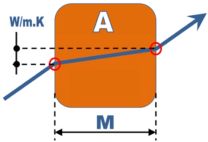
The drawings above show the thermal conductivity (arrow) or the thermal resistance of single layer and multilayer insulation materials. The first drawing on the left shows a single layer insulation material (A) with thickness (M) and a certain thermal conductivity or thermal resistance which is shown by the inclination of the arrow. The steeper the inclination of the arrow, the higher the conductivity or the lower the thermal resistance of the material. When we take a closer look at the first drawing we can also see that the arrow is starting very steep until it reaches the material. The arrow is declining and creating a more horizontal line meaning that the thermal energy or the temperature is experiencing more resistance when it is penetrating the material. At the end of the material we can see that a thermal energy of W/m.K has penetrated through the material. Ones penetrated, the thermal heat is experiencing lesser resistance so the arrow is steeper again.
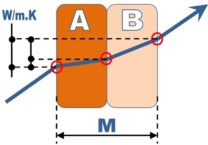
The second drawing shows a multilayer insulation set-up consisting out of two materials (A) and (B) with a combined thickness of again (M). The arrow shows also the thermal conductivity through the materials where the drawing shows that the thermal conductivity of material (B) is bigger (steeper arrow) than material (A). This also means that this combination has a lower thermal resistance than the single layer material meaning that the single layer insulation material is a better insulator than the multilayer composition. The goal of this combination is clearly not to create better insulation performances.
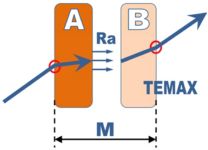
The last drawing on the right shows a special multilayer insulation material where a air-cavity was created between both individual materials (A) and (B). This air-cavity offers the big advantage that the penetrating thermal energy cannot flow directly from (A) to (B) through conduction, but needs to change into radiation (Ra) to reach material (B). This phenomenon creates a big slow-down or delay in the speed of the thermal energy transfer or travel and creates a big increase in the thermal resistance of the total composition being (material A + B + air-cavity). This delay or slow-down of the traveling of thermal energy can even be extra delayed when a passive or active ventilation technique is implemented in the air-cavity.
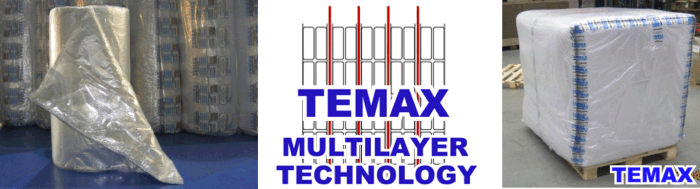
The drawing on the left shows the Temax-4000 insulation material in which four (4) reflection layers are strategically integrated to offer strong reflection capacities against heavy heat radiation. Within the Temax-4000 material a number of ingenious heat resistance techniques are implemented combined with special passive ventilated air-cavity technologies to generate a flow of heated and cooled air inside the insulation material. This unique technique creates an extra strong thermal resistance against conducting thermal heat through the insulation material.
In short, the Temax insulation material is unique in its kind and can be specified as revolutionary in its category of insulation materials. A number of special insulation techniques and technologies have been implemented into the design to offer a thermal resistance against strong radiation and conduction heat transfer. This also explains why Temax has been nominated to be the best insulator in its kind. Do you have questions in regards of the Temax material, our engineers will be glad to answer your questions.
The Temax multilayer thermal blanket is used in the cold chain logistics (Airfreight – Sea freight – Road freight) to transport time-temperature sensitive products or conditioned products (fresh – frozen – ambient) such as pharmaceuticals or healthcare products, food perishables, chemicals, etc… The Temax multilayer thermal blanket functions as a passive cooling system in which the goal is to protect or preserve the temperature of the product as long as possible during external temperature excursions (hot or cold). The Temax multilayer thermal blankets can be used on rolls, which are cut to size by the user and wrapped according specified protocols and S.O.P’s (Standard Operation Procedures), or they can be tailor made to thermal covers. These tailor made products can be created according to the required dimensions, the required insulation quality, shapes and models, etc… If you have any special requests for multilayer thermal blankets for your cold chain application, please feel free to contact us. Our consultants and engineering will be glad to assist you
Contact
The company Krautz-TEMAX is a global manufacturer. Therefore we cannot publish product prices online. May we kindly ask you to write us a small email on your request and we will be happy to send you our product overview with prices. We aim to respond to your message within 24Hrs.
KRAUTZ - TEMAX
Temax Pharma